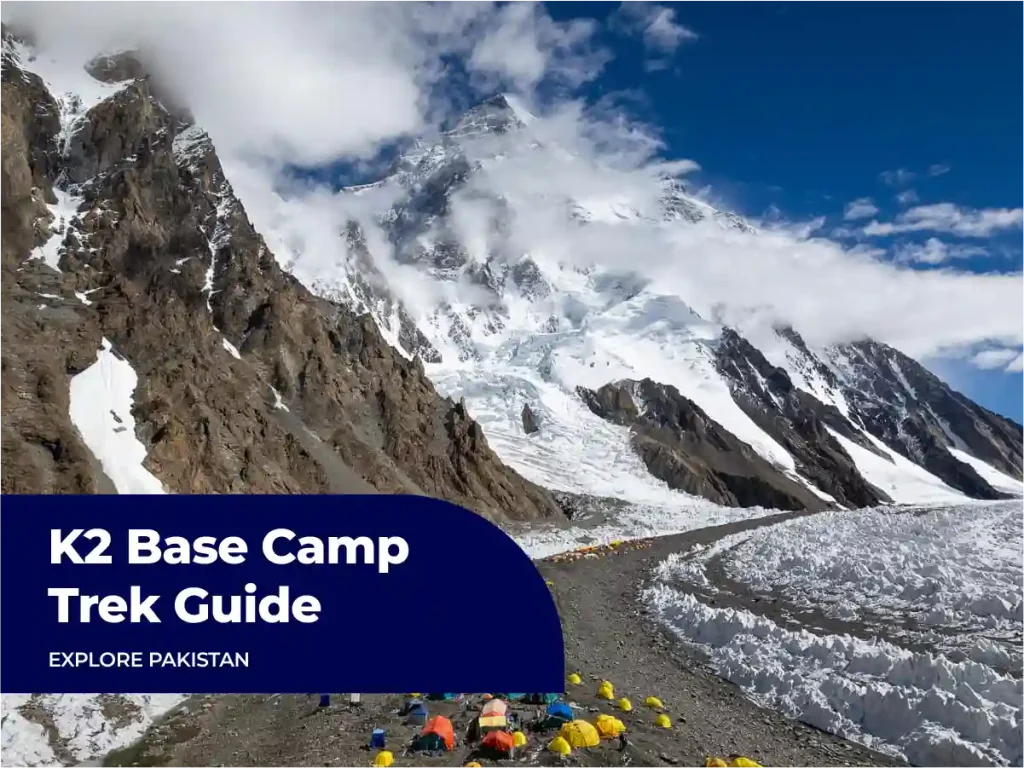
The K2 base camp trek takes you deep into the Karakoram range of Gilgit-Baltistan, Pakistan, to the foot of K2, the second highest mountain in the world at 8,611 meters. This guide covers the real route, a day-by-day itinerary, an honest cost breakdown, permits, training, and safety, so you can decide if this expedition-level trek is right for you.
Key Takeaways
- The K2 base camp trek runs roughly 100 to 110 km round trip along the Baltoro Glacier, taking 12 to 14 trekking days plus travel days, for a total trip length of about 18 to 22 days.
- K2 Base Camp sits at approximately 5,150 meters, and the trek’s hardest optional add-on, the Gondogoro La pass, tops out near 5,585 meters.
- Expect to pay roughly USD 2,500 to 4,500 per person for a full-service guided trek, depending on operator, group size, and whether you add the Gondogoro La crossing.
- A licensed guide and government-issued NOC permits are legally required, since this route runs through Central Karakoram National Park and a restricted border region.
- This trek is longer and more remote than Everest Base Camp, but not more technically difficult on the standard route, which makes fitness and stamina more important than climbing skills.
What Is the K2 Base Camp Trek?
The K2 base camp trek is a multi-week camping expedition that follows the Baltoro Glacier from Askole village to the foot of K2, through the heart of Central Karakoram National Park. Unlike a lodge-based trek, there are no teahouses out here. You sleep in tents every night once you leave Askole, supported by porters and a trekking crew.
The full round trip covers roughly 100 to 110 km, and most guided itineraries run 12 to 14 days of actual trekking, with 4 to 6 additional days built in for travel between Islamabad, Skardu, and Askole, plus weather buffer days. All told, plan for an 18 to 22 day trip from Islamabad and back.
This is not a casual walk. At Eagles Adventure, we tell people to think of it as a serious camping expedition through some of the most remote high-altitude terrain on the planet, surrounded by four of the world’s fourteen eight-thousand-meter peaks.
This route sits within the Karakoram range, part of the same broader mountain system as the Himalayas, in the far north of Pakistan near the borders of China and India. It is also sometimes called the Baltoro Glacier trek or the Concordia trek, since Concordia is the dramatic glacial junction that most trekkers remember best.
K2 Base Camp Elevation & Route Overview
K2 Base Camp sits at approximately 5,150 meters, reached via the Baltoro Glacier and the Godwin-Austen Glacier, with Concordia acting as the major junction point along the way. The standard route starts in Skardu and works like this:
- Skardu to Askole: a scenic drive along the Indus and Shigar valleys, ending at Askole, the last permanent village before the wilderness.
- Askole to Concordia: several days of trekking on and alongside the Baltoro Glacier, the world’s fifth-longest glacier outside the polar regions at roughly 63 km, passing camps like Jhola, Paiju, Urdukas, and Goro II.
- Concordia: often called the Throne Room of the Mountain Gods, this glacial junction offers a 360-degree view of K2, Broad Peak, and Gasherbrum I and II all at once.
- Concordia to K2 Base Camp: a day trip along the Godwin-Austen Glacier, passing the Gilkey Memorial, a somber tribute to climbers lost on K2, before reaching base camp itself.
- Return: either back the same way to Askole, or via the tougher Gondogoro La pass for a full traverse ending in Hushe village.
[Insert route map graphic here, showing Skardu, Askole, Baltoro Glacier, Concordia, and K2 Base Camp]
How Difficult Is the K2 Base Camp Trek?
This trek is physically demanding but not technically difficult on the standard route, meaning you need serious stamina and altitude tolerance rather than climbing or rope skills. You will walk 6 to 8 hours a day, often on uneven glacier moraine, for close to two weeks straight, at altitudes between 3,000 and 5,150 meters.
The challenge comes from cumulative fatigue, not any single hard day. Rocky, unstable glacier terrain slows your pace and tires your legs more than a smooth trail would. Weather swings fast, from intense sun to sudden snow, even in summer. And because you are camping the entire way, there is no warm lodge to retreat to on a bad day.
If you plan to add the Gondogoro La crossing, that changes the difficulty picture. The pass involves fixed ropes and a long 8 to 12 hour summit-style push, and it is the most demanding single day of the whole trip.
K2 Base Camp vs Everest Base Camp
Both treks end at a base camp beneath an 8,000-meter peak, but they are different trips in almost every other way. Here is how they stack up:
| Factor | K2 Base Camp Trek | Everest Base Camp Trek |
| Accommodation | Camping the entire way | Teahouses and lodges |
| Trek length | 12-14 trekking days | 8-9 trekking days |
| Terrain | Rocky glacier moraine | Established mountain trail |
| Crowds | Low, remote | High, especially in peak season |
| Mountain view | You stand at the foot of K2 itself | Everest is viewed from a distance |
| Infrastructure | Minimal, self-supported camping | Wi-Fi, hot showers, bakeries available |
The honest answer to “which is harder” is that K2 base camp demands more from your body over more days, with less comfort at the end of each one, while Everest Base Camp is more accessible for a broader range of trekkers thanks to its teahouse trail and shorter timeline.
How Much Does the K2 Base Camp Trek Cost?
As of July 2026, a full-service guided K2 base camp trek typically costs between USD 2,500 and 4,500 per person, depending on the operator, trip length, group size, and whether the Gondogoro La crossing is included. Budget operators run trips closer to USD 1,990 to 2,500, while premium international operators with smaller groups and extra support can charge USD 5,000 or more.
Here is a rough itemized breakdown for a standard 20-day trip:
| Item | Estimated cost (USD) |
| Central Karakoram National Park (CKNP) permit | 150 to 300 |
| Gilgit-Baltistan adventure / trekking fee | 150 to 200 |
| Guide and porter fees (for the full trek) | 600 to 1,200 |
| Camping equipment, food, and cook staff | 500 to 900 |
| Islamabad-Skardu domestic flights (round trip) | 150 to 250 |
| Jeep transport, Skardu to Askole and back | 100 to 200 |
| Islamabad hotel nights (before and after) | 100 to 200 |
Most reputable operators bundle these into one all-inclusive price, which is simpler and safer than trying to piece it together yourself. What is usually excluded: international flights to Islamabad, travel insurance with high-altitude rescue coverage, personal gear, tips for your crew, and emergency evacuation, which through the Pakistani military can run into the tens of thousands of dollars if a helicopter rescue is needed. This is exactly why solid travel insurance is non-negotiable for this trek.
On our tours, we itemize every one of these costs upfront, so there are no surprise add-ons once you are already committed to the trip. If a quoted price looks dramatically lower than the ranges above, it is worth asking exactly what is and is not included, since permits, staff wages, and safety equipment are not places to cut corners on a trek this remote.
Best Time to Trek to K2 Base Camp
The trekking season runs from June through September, with July and August considered the most reliable window for stable weather and manageable glacier conditions.
- June: Early season, cooler temperatures, and some snow may still linger at higher camps.
- July to August: Peak season. Warmest, most stable weather, and the busiest month for group departures.
- September: Weather is still generally good, with fewer crowds, though nights get noticeably colder.
- October onward: Not recommended. Snow and cold make the glacier crossing and camping conditions much harder.
Outside of June through September, most operators simply do not run trips, since the Baltoro Glacier route becomes too unpredictable and cold for standard camping gear.
Day-by-Day Itinerary
Here is a representative itinerary based on how most operators structure the trip. Exact day counts vary slightly by operator and whether you include the Gondogoro La option.
| Day | Route | Approx. altitude |
| 1-2 | Islamabad, fly or drive to Skardu | 2,500m |
| 3 | Skardu to Askole by jeep | 3,000m |
| 4-5 | Askole to Jhola, then to Paiju | 3,150-3,450m |
| 6 | Rest and acclimatization day at Paiju | 3,450m |
| 7-9 | Paiju to Khoburtse, Urdukas, and Goro II | 3,800-4,300m |
| 10 | Goro II to Concordia | 4,600-4,700m |
| 11 | Day trip to K2 Base Camp and back to Concordia | 5,150m |
| 12 | Optional: Broad Peak Base Camp visit | 4,800m |
| 13-15 | Return trek, or Gondogoro La crossing to Hushe | 3,000-5,585m |
| 16-18 | Drive back to Skardu, fly to Islamabad | – |
Skardu to Askole and the trek in
The trip starts with a scenic but rough jeep ride from Skardu to Askole, the last village before the wilderness. This is where your trekking crew, porters, and cook team finish organizing supplies, since nothing resupplies from here until you are back. From Askole, the first two to three trekking days head toward Jhola and Paiju, following the Braldu River and crossing the Biafo Glacier’s edge, with your first proper views of the Baltoro peaks starting to appear.
Baltoro Glacier to Concordia
From Paiju, the route moves onto the Baltoro Glacier itself, the world’s fifth-longest non-polar glacier at around 63 km. Over several days you pass Khoburtse, Urdukas, and Goro II, walking on uneven moraine with the Trango Towers, Masherbrum, and Mustagh Tower rising around you. This stretch is where the cumulative altitude and terrain start to add up, so a slow, steady pace matters more than speed.
Concordia to K2 Base Camp
Concordia, sitting around 4,600 to 4,700 meters, is the payoff moment of the whole trek: a wide glacial junction with four eight-thousanders visible at once, including K2 itself, which stays hidden until this exact point. From Concordia, most groups do K2 Base Camp as a long day trip along the Godwin-Austen Glacier, passing the Gilkey Memorial, then returning to sleep at Concordia rather than at base camp, since the extra altitude gain offers little benefit for a short overnight stay.
Optional: the Gondogoro La crossing
Instead of retracing the same route back to Askole, some operators offer a return via the Gondogoro La pass, at roughly 5,585 meters. This adds a genuinely tough, technical day involving fixed ropes and 8 to 12 hours of effort, but rewards you with a view of all four nearby eight-thousanders from one spot and a different, less repetitive route out through the Hushe Valley.
Permits & Documents: Visa, NOC & Park Fees
Anyone trekking to K2 Base Camp needs a Pakistani visa, arranged in advance for most nationalities, along with two specific local permissions: a Central Karakoram National Park permit and, in some cases, an NOC, which stands for No Objection Certificate, a government permission document required for travel in certain restricted zones near sensitive borders.
A registered, licensed trekking operator is legally mandatory for this route, and this is not just a formality. Your operator handles the CKNP permit, any NOC paperwork, and registration with the local tourism department in Skardu before you set out. Attempting to arrange this trek independently without a licensed operator is not realistically possible under current regulations, which is one reason booking with an established operator matters so much here, both for legality and for safety in a genuinely remote environment.
Training & Fitness Preparation
Because you will be walking 6 to 8 hours a day for close to two weeks on uneven terrain, your training should focus on stamina and leg strength, not just general gym fitness. Start your prep at least 3 to 4 months out if you are not already an active hiker, and treat consistency as more valuable than intensity.
- Build up to long hikes, 4 to 6 hours, on hilly terrain with a loaded daypack, at least once a week.
- Add stair climbing or step-ups with weight to build the specific leg strength needed for uneven glacier moraine.
- Include cardio sessions like running, cycling, or the stair machine, 3 to 4 times a week, to build your aerobic base.
- Practice back-to-back long walking days, since the trek’s fatigue is cumulative rather than a single hard day.
- Get some experience camping and sleeping in a tent multiple nights in a row, if possible, since this trek offers no lodge nights at all past Askole.
Packing List for the Karakoram
You need gear for a genuine camping expedition at altitude, with big temperature swings between day and night.
- Four-season sleeping bag rated for below freezing temperatures
- Sturdy, broken-in trekking boots with ankle support for uneven moraine
- Trekking poles, which help a lot on loose glacier rock
- Base layers, insulated mid layer, and a proper down jacket for camp evenings
- Waterproof and windproof outer shell, both jacket and pants
- Warm hat, sun hat, gloves, and sunglasses with strong UV protection
- Gaiters, useful for scree and loose glacier debris
- Headlamp with spare batteries
- Water purification tablets or a filter, plus a wide-mouth bottle
- Basic personal first aid kit, including blister care and any personal medication
- If crossing Gondogoro La: crampons and a climbing harness, usually provided or arranged by your operator
Altitude, Health & Safety on the Trek
Altitude sickness is a real risk on this trek, since you spend extended time above 3,500 meters and reach over 5,000 meters at base camp. A well-planned itinerary builds in rest and acclimatization days, especially around Paiju and before pushing on toward Concordia.
- Watch for headache, nausea, dizziness, or unusual fatigue, and tell your guide immediately if you notice symptoms.
- Never push higher if symptoms are getting worse. Descending is the single most effective treatment for altitude sickness.
- Stay hydrated and avoid alcohol, since dehydration makes altitude symptoms worse.
- Carry comprehensive travel insurance that specifically covers high-altitude trekking and helicopter evacuation, since rescue costs in this region can run into the tens of thousands of dollars and are not covered by standard travel policies.
- Rescue and evacuation infrastructure here is limited compared to more developed trekking regions, so a licensed guide and a well-prepared operator genuinely matter for your safety, not just your permits.
Frequently Asked Questions
How long is the K2 Base Camp trek?
The trek itself typically takes 12 to 14 trekking days, covering roughly 100 to 110 km round trip. Including travel days between Islamabad, Skardu, and Askole, plus weather buffer days, most full trips run about 18 to 22 days from start to finish.
Can beginners do the K2 Base Camp trek?
This trek is possible for fit beginners with no technical climbing experience, but it demands strong stamina, since you will walk 6 to 8 hours daily for close to two weeks on rough terrain. Beginners should train seriously for several months beforehand and go with an experienced operator who can manage pacing and acclimatization.
Do you need a guide for K2 Base Camp?
Yes, a licensed guide and registered trekking operator are legally required, since the route passes through Central Karakoram National Park and a restricted border region. Beyond the legal requirement, a guide is essential for navigation, permits, and safety in this remote, camping-only environment.
How high is K2 Base Camp?
K2 Base Camp sits at approximately 5,150 meters above sea level. This is notably higher than most trekkers experience on a standard hike, so proper acclimatization on the way up is important to avoid altitude sickness.
Is K2 Base Camp harder than Everest Base Camp?
K2 Base Camp is generally considered more physically demanding, mainly because of its longer duration, full camping setup, and rougher glacier terrain, though it is not more technically difficult on the standard route. Everest Base Camp benefits from teahouse accommodation and a shorter, more established trail.
Are there showers and Wi-Fi on the trek?
No. This is a full camping expedition with no teahouses, so there are no showers, and Wi-Fi or reliable phone signal is essentially nonexistent past Askole. Some operators carry satellite communication devices for emergencies, but plan to be fully offline for the trekking portion.
What do porters carry and what do I carry?
Porters carry the bulk gear, including tents, food, kitchen equipment, and your main duffel bag, while you carry a daypack with water, snacks, layers, camera gear, and anything you need during the day’s walk. This division of labor is standard on Karakoram treks and is factored into your trek cost.
Thinking about tackling the K2 base camp trek? Get in touch with our team to start planning your Karakoram expedition, or explore more of our domestic adventures across northern Pakistan.
Eagles Adventure is a leading travel company in Pakistan, providing domestic, international, and Umrah tours with exceptional safety, comfort, and memorable experiences.